Seagrass vs. Seaweed: A Simple Comparison for Bay Walkers
Halfway along the beach path, most walkers do the same thing: they stop, crouch, and poke at the tangle of green at the waterline. Then comes the guess — seagrass or seaweed? — usually made in a hurry and often wrong. It is a small mistake with a real cost, because these two are not near-relations with slightly different habits. One is a flowering plant that builds nurseries for fish. The other is an alga that plays by entirely different rules. Learning to tell them apart takes about five minutes of practice, and it changes what you notice on every walk around the bay.
One Is a Plant, One Is an Alga
The most useful thing to keep in your head is this: seagrasses are true plants. They have roots, a creeping underground stem called a rhizome, leaves with veins running through them, and — though almost nobody sees it — flowers and seeds. Around these shores the big one is Posidonia oceanica, whose ribbon leaves turn leathery and dark with age, alongside the narrower Zostera and Cymodocea. All of them anchor themselves in sand or mud and hold on with a proper root system.
Seaweeds are algae, and that changes everything about how they work. No roots, no veins, no flowers. The root-like structure you see at the base is a holdfast, and its only job is to grip rock. It does not deliver water or nutrients. Those come in through the whole blade, straight from the sea around it. Seaweeds reproduce by spores rather than seeds, and they grow fast — some blades lengthen by several centimetres a day in good conditions.
What to Look At in Your Hand
Once a piece of green is in your palm, the diagnosis is usually quick. Work through these checks in order; the first two settle most cases on their own.
- Veins. Hold a leaf up against the sky. Seagrass leaves show faint parallel lines running their length. Seaweed blades are more or less uniform — sometimes with a single midrib, but never with a veined pattern.
- The bottom end. A frayed tuft of fine roots with a little sandy rhizome attached means seagrass. A disc, a pad or a knot of tough fibres that once gripped a rock means seaweed.
- Air bladders. Small round floats along the stem are a seaweed feature. Seagrass does not have them.
- Texture and snap. Seagrass leaves feel like damp paper or thin leather and tear in straight lines. Most seaweeds are slippery, rubbery or filmy, and either squash in the fingers or snap cleanly.
- Smell. Fresh seaweed is sharply marine, almost iodine-like; rotted wrack can be pungent. Seagrass smells like mown grass, and dried leaves smell of hay.
- Colour, cautiously. Both can be green, so colour alone decides nothing. Brown and red tones point to seaweed, but old Posidonia leaves go brown-black and fool plenty of people.
Let the Location Narrow It Down
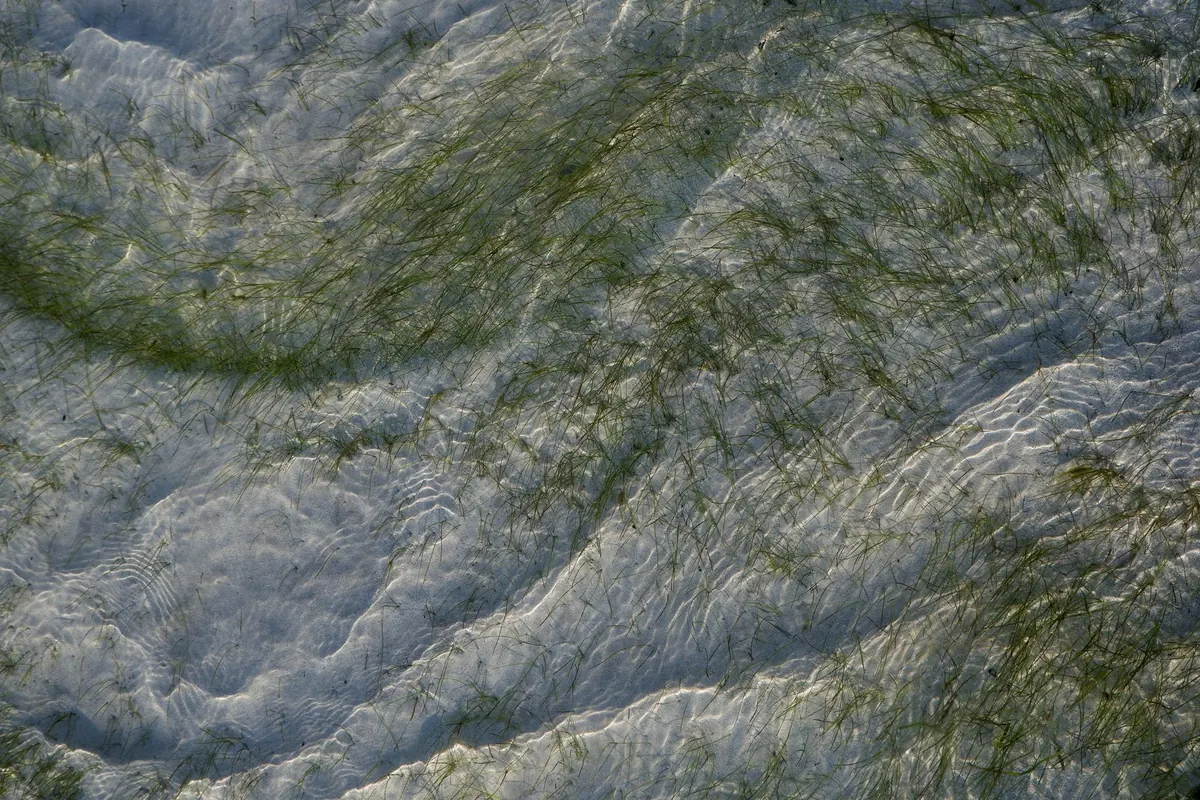
Where you found a piece often answers the question before you pick it up. Seagrass grows in soft ground: sand, mud, sheltered shallows, the kind of place where you can see dark underwater patches through clear water on a calm morning. It needs light, so it stays in the shallows, and it stays put — a meadow is a permanent structure that persists for years.
Seaweed is a creature of hard surfaces. Rock pools, boulders, harbour walls, mooring ropes, the shells of mussels and even the backs of crabs. It is held down against waves by grip alone, not by soil.
That difference makes the wrack line easy to read. A blade of seaweed lying on a sandy beach almost certainly arrived from somewhere else, thrown up by a storm. A dense raft of brown leaves at the tide line on a Mediterranean beach is far more likely to be dead seagrass, washed out of the meadow just offshore — what coastal people call a banquette.
Two Very Different Jobs in the Bay
A seagrass meadow is architecture. The leaves slow the water, so waves lose energy and sediment settles instead of clouding the bay. The rhizome mat locks the seabed down, which is why meadows survive storms that strip bare sand away. All that three-dimensional structure is shelter: juvenile fish, small crustaceans and sea slugs live in the canopy and among the stems, which is exactly why seagrass beds are treated as nursery grounds.
Seaweed works more like a filter that grows back. It takes up nutrients from the water as it expands, and it is grazed hard by limpets, snails and urchins. When it breaks loose, the story continues on the beach: rotting wrack feeds sandhoppers, flies and small beetles, which in turn feed the birds working the shoreline. Dead seaweed also returns organic matter to the sand. Nothing in that chain is wasted.
A note on protected ground
In much of the Mediterranean, Posidonia meadows are legally protected habitat, and removing banquettes from beaches is regulated in many places because those piles of dead leaves protect the sand from erosion. Leave them where they lie. Take photographs, not handfuls.
Three Confusions Worth Knowing
Sea lettuce and eelgrass
Sea lettuce (Ulva) is a bright green alga with thin, translucent, ruffled sheets. It grows fast in nutrient-rich water and often carpets shallow rock. Eelgrass is a genuinely green seagrass with long, narrow, opaque leaves and a root system. If the green is see-through and crinkled like damp cellophane, it is not a plant.
Caulerpa, the invader
Some green seaweeds in the genus Caulerpa spread aggressively across Mediterranean seabeds and are treated as invasive. They look like feathery green fronds rising from a creeping runner — no veins, no roots, and a texture closer to soft plastic than to a leaf. If you see dense mats of it while snorkelling, that is worth reporting to a local marine reserve or coastguard office.
Dead seagrass that looks like weed
Old Posidonia leaves bleach, fray and clump into fibrous brown bundles that resemble coarse seaweed. Look for straight parallel fibres and a papery stiffness; seaweed dries into a thinner, more brittle film or a rubbery strip. Even half-recognised, both belong on the beach, so put them back.
A Five-Minute Routine for the Waterline
Next time you walk the bay, try this in order. It works on almost any shoreline and takes less time than reading this page.
- Stop at the strandline first and look without touching. Note whether the ground beneath you is sand or rock.
- Pick up one piece only, and turn it so the base faces you. Roots or holdfast?
- Hold a leaf against the sky for veins.
- Crush a small fragment between finger and thumb and smell it.
- Put it back where you found it, and make a mental note of the spot — the same beach will show you something different after the next storm.
Low tide after a spell of onshore wind is the best window: the wrack line is fresh, the water is often clearer, and you can see attached seaweed in the rock pools without getting wet past your knees. Take a hand lens if you have one. Wear shoes with grip on wet rock, and keep an eye on the swell rather than on your feet.
And when you are unsure, the safest answer is usually the boring one: if it has roots and veins, it was growing in the bay and belongs to the meadow; if it has a holdfast and a slippery blade, the sea delivered it. Either way, you are holding a piece of the coastline's working machinery — worth a closer look, not worth carrying home.
Photo: Andrei Simon Amisi / Pexels
Why Local Fishermen Watch Wind and Tides: A Bay Story
In one Mediterranean bay, fishermen read wind, tide and the water's small signals before dawn — habits any...

How to Photograph Coastal Wildlife Without Disturbing It
Practical field craft, camera settings and distance rules for photographing coastal wildlife so the animal...
About Us